ION Joins EU Recycling Consortium That Includes Carmaker Porsche
Our recycling tech Investment IonDrive (ASX: ION) is now a part of a major European battery recycling consortium.
The consortium includes the likes of Porsche Consulting (a subsidiary of the car maker).
As a consortium member ION’s tech will now be independently evaluated against other recycling technologies.
Basically, it's a chance for ION to show the industry how its tech stacks up against competitors from a sustainability, cost-efficiency, and performance perspective.
ION’s recycling tech is a chemical process that combines “Deep Eutectic Solvents” together with “benign organic solvents”.
It uses way less energy than other methods, and has less need for acids.
Being a chemical process based on biodegradable solvents, ION’s metals extraction technology is NOT energy or acid intensive…
Just last week ION received a A$3.9M grant (non-dilutive to shareholders) to scale up its tech and commence building their pilot plant for lithium, nickel and cobalt recovery from old batteries.
And ION is actively working on opportunities to apply its tech to other critical metals/minerals like rare earths, gold, copper and silver.
Those are all the ones ION has mentioned to date.
Below is a larger list of metals that Deep Eutectic Solvents (which ION uses in its IP protected processing technology) have been tried and tested on in metals extraction and recycling - we’ve highlighted some of the key critical metals:
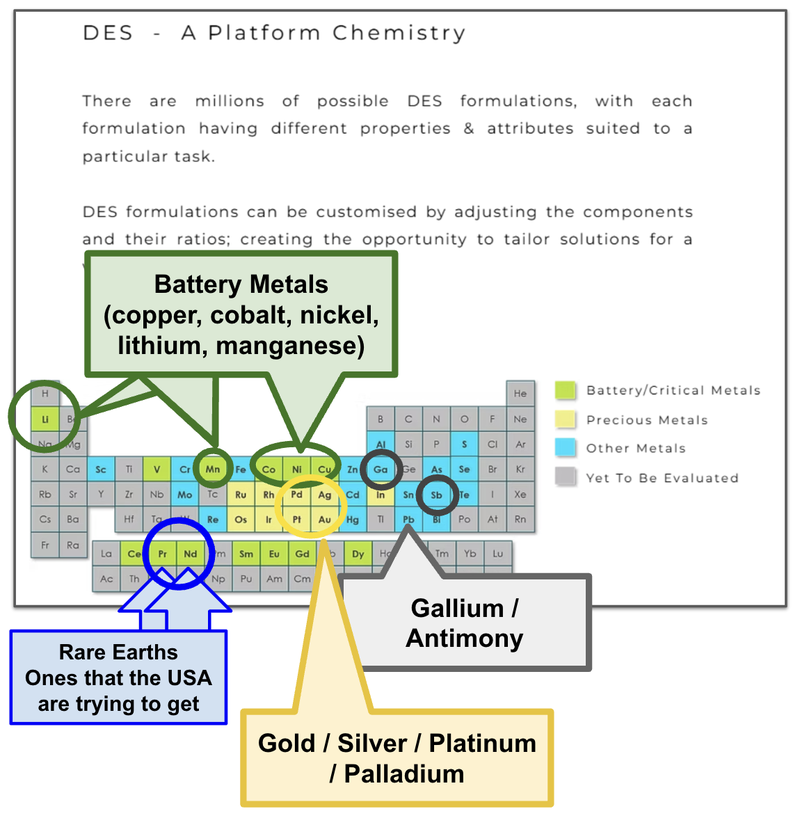
(Source)
Today’s announcement will see ION’s tech get included in a Life Cycle Assessment (LCA) - which is basically a study that compares different technologies over their entire useful lives.
Usually the LCA is looking to compare environmental impacts/performance of a project and then benchmark it against its industry competitors.
After the assessment is completed we should get a pretty good idea of how ION’s tech stacks up against other recycling technologies from a cost and environmental sustainability perspective.
With the LCA being independent and done by a leading “European consortium”, this should result in a boost to ION’s credibility with customers and regulators, improving future licensing, partnerships, funding and commercial opportunities.
Inside the EU ION has gone for a €3.1 m grant, so we are hoping this LCA helps improve ION’s chance of getting that funding.
What’s next for ION:
Over the next 6-9 months, we think one (or multiple) of the below catalysts could trigger a sustained re-rate in ION’s market cap:
- Pilot plant build for battery recycling tech - as mentioned earlier, we think this will be a big inflection point for ION. ION expects to have the plant built and commercially producing by “early 2026”.
- EU grant decision - ION has also applied for a €3.1M EU grant with an OEM consortium. We expect an update within the next 3 months.
- ION’s mineral processing tech gets de-risked - ION is currently testing its technology on “US sourced feedstock”. Any big feedstock supply deal, partnership deal or any strong recovery results could be a big unexpected catalyst for ION.
- Application into new markets - Here, ION is looking at recovering copper, gold, silver, osmium and rare earth elements from e-waste (Printed Circuit Boards). Results from these tests could come at arbitrary times. We could see the market re-rate ION if the results are positive.
- Graphite upgrade results - updates on this front came from a recent ION’s announcement. If ION can produce anode-grade graphite from recycled black mass, it could add to the economics of its pilot plant and strengthen the commercial case for a bigger plant. See our Quick Take on that news here.
- [New] US rare earths partnership - According to the recent interview with ION’s CEO the company is looking to partner with a number of companies in the US to deploy its technology to recover rare earth elements.